
Data Centers, Water, and the Question Michigan Hasn’t Fully Answered Yet

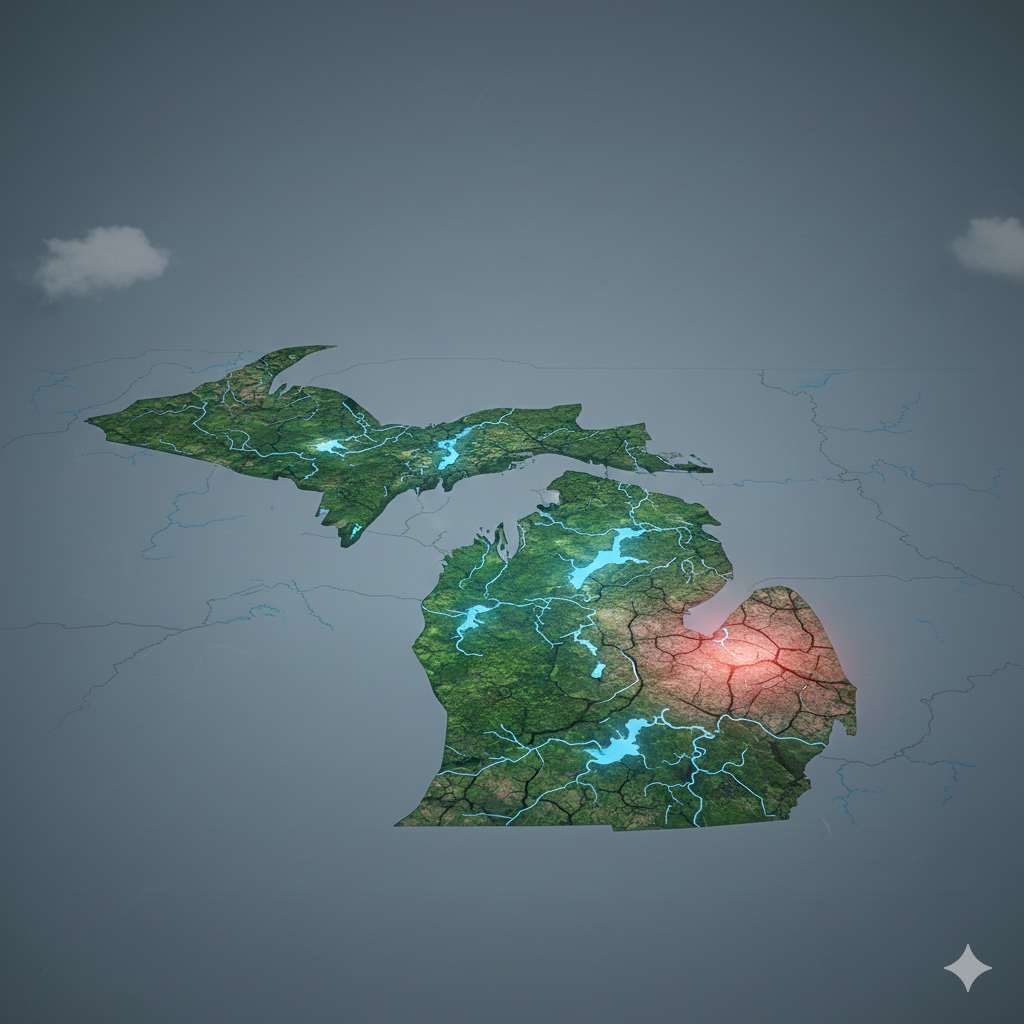
By Chelsea Lynn Michigan is increasingly attractive to data center developers. The reasons are straightforward: relative proximity to population centers, access to transmission infrastructure, available land, and—most often cited—abundant freshwater. That final point deserves careful examination, not because data centers are inherently harmful, but because water systems operate on constraints that are often invisible until they are stressed. This is not an argument for or against data centers. It is an argument for precision, transparency, and proportional decision-making when siting infrastructure that depends on large and continuous resource inputs. How Data Centers Use Water Most large data centers use water primarily for cooling. The dominant method, evaporative cooling, removes heat by allowing water to evaporate, which consumes water in the process. Depending on size, climate, and design, a single hyperscale facility may use anywhere from several million to several hundred million gallons of water annually. That range is broad because designs differ. Some facilities rely on closed-loop systems that recycle water, while others use once-through or hybrid models. Water demand also varies seasonally and spikes during heat waves—precisely when municipal and ecological systems are already under stress. Importantly, this water is not simply “borrowed.” Evaporated water does not return to the local watershed. Over time, withdrawals and losses must be balanced against recharge rates, competing users, and long-term hydrologic stability. Context Matters — Comparisons Matter More Large numbers can mislead without context. Data center water use is often compared to households, agriculture, or power plants, but these comparisons are rarely apples-to-apples. Municipal systems prioritize human consumption and sanitation. Agriculture is often seasonal and tied to food systems. Power plants typically return a portion of withdrawn water, albeit warmer. Data centers differ in that their demand is continuous, non-seasonal, and often contractually guaranteed, regardless of drought or local conditions. This does not make them uniquely dangerous—but it does make them structurally different, and therefore deserving of site-specific analysis rather than blanket assumptions. Michigan’s Hydrogeology Is Not Uniform Michigan’s groundwater systems vary widely. Some regions are protected by clay-rich soils; others sit atop highly permeable glacial deposits that allow rapid movement of water—and contaminants—between the surface and aquifers. In permeable regions, risks associated with industrial activity are not hypothetical. Diesel fuel for backup generators, water treatment chemicals, and thermal discharge all require careful containment. Modern engineering standards mitigate these risks, but mitigation effectiveness depends on enforcement, monitoring, and long-term maintenance—not just design specifications. A statewide resource demands localized scrutiny. Energy Demand and Indirect Water Effects Data centers are energy-intensive. Increased electrical demand can have indirect water consequences depending on how utilities respond. In regions where additional demand extends the operating life of fossil-fuel plants, water use and emissions can increase locally, even as statewide clean energy targets remain intact. In regions where renewable capacity is rapidly added, impacts may be lower. The outcome is not predetermined—but neither is it automatic that new demand aligns smoothly with clean energy timelines. Governance, Not Technology, Is the Real Variable The most significant unanswered questions are not technical. They are procedural. Across the Midwest, communities have raised concerns about: Limited public disclosure of water use agreements Non-public utility contracts Economic development incentives negotiated under confidentiality clauses None of these practices are inherently improper. Confidentiality exists for legitimate reasons. But when decisions affect shared resources—especially groundwater—public trust depends on visibility into assumptions, tradeoffs, and enforcement mechanisms. Transparency is not opposition. It is infrastructure. What a Proportionate, Neutral Standard Looks Like A neutral approach does not block development. It sets conditions: Site-specific hydrologic studies conducted before approval, not after Public disclosure of projected water use ranges, including seasonal peaks Clear contingency plans for drought or system stress Binding commitments, not aspirational targets, for water efficiency Ongoing monitoring with publicly accessible data These standards protect communities, developers, and regulators alike by reducing uncertainty on all sides. The Question Is Timing, Not Technology Michigan’s water advantage is real—but it is not infinite, and it is not evenly distributed. Decisions made today will shape availability decades from now. The choice facing policymakers is not whether to welcome advanced infrastructure. It is whether to do so at a pace and scale aligned with hydrologic reality, public confidence, and long-term stewardship. That question deserves answers grounded in data, not urgency—and in process, not polarization.