
“Just Say No” Didn’t Work Then. It Won’t Work for Data Centers Now.

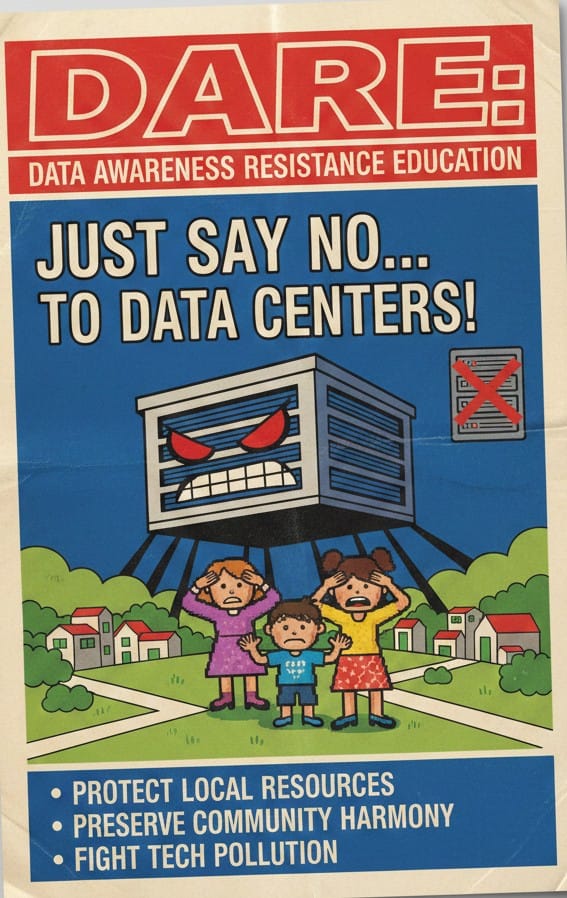
By Chelsea Lynn — December 19, 2025 In the 1980s and 1990s, the United States invested heavily in a simple slogan: Just Say No. Through the D.A.R.E. program, children were taught that drug abuse could be prevented through willpower and obedience to authority. The message was clear, comforting, and politically popular. It was also ineffective. Decades of research show D.A.R.E. did not reduce drug use, and in some cases increased curiosity. The reason was simple: the program treated a complex, system-driven problem as a matter of individual choice. Children were expected to resist drugs without any influence over the social and economic conditions that made substances accessible. Symbolic messaging replaced structural solutions. Today, a similar logic is applied to public opposition to large-scale data center development. Communities are encouraged to “speak up,” attend public meetings, submit comments, and “just say no” if they object. On the surface, this appears empowering—but the analogy to D.A.R.E. lies in the difference between symbolic participation and real power. Data center projects are shaped by corporate demand, utility contracts, state-level approvals, tax incentives, and long-term energy planning. By the time the public is invited to comment, many key decisions have already been made. This approach shifts responsibility onto residents while leaving authority elsewhere. Opposition is framed as a matter of participation rather than leverage. If projects proceed despite community objections, the implicit message is that residents didn’t organize enough — echoing D.A.R.E.’s moralistic logic: if outcomes fail, blame the people subject to the system, not the system itself. Trust erodes further when official messaging conflicts with lived experience. Public assurances often emphasize minimal impact, local job creation, and technological progress. Meanwhile, residents may face real consequences: increased electricity use and grid strain, heavy water consumption, noise, and land-use changes. Tax abatements intended to bring economic benefit may deliver little to the local community. When promises diverge from reality, skepticism is rational, not cynical. Concrete solutions are often absent. Communities rarely have binding environmental limits, enforceable infrastructure guarantees, independent oversight, revenue-sharing agreements, or genuine veto authority. Public engagement becomes performative, rather than participatory. Input is welcomed; power is not shared. The result is frustration and a sense of helplessness, even among those willing to participate fully. The lesson from “Just Say No” is clear: slogans alone do not solve structural problems. Real solutions require transparency, enforceable standards, and shared authority. If data centers are truly necessary for the modern economy, communities should receive binding environmental protections, guaranteed infrastructure investments, independent audits, and a direct stake in project outcomes. Participation must carry real weight, not just a symbolic microphone. This is not opposition to technological progress or economic development. It is a call for accountability, equity, and democracy in decision-making. Until public participation carries genuine power, telling people to “just say no” is theater, not civic engagement. And history shows how that story ends.